Ganglion, Dupuytrens & Tendon Disorders
Ganglion :: Dupuytrens :: Tendon Disorders
Ganglions and other Tumours of the Hand
Ganglion cyst - These are non cancerous raised lumps typically found near joints such as the wrist and fingers, but can occur anywhere on the body. When ganglion cysts compress nearby nerves, surgical removal is indicated.
Neuroma or nerve tumors can be formed on the peripheral nerves, the nerves that link the brain and spinal cord to the rest of the body. The tumors may be benign or malignant. Benign tumors are non-cancerous and do not spread to the surrounding tissues or cells while malignant tumors are cancerous and spread to other tissues or cells.
Nerve biopsy is performed to determine if the neuroma cells are benign or malignant. Other diagnostic tests your doctor may order include magnetic resonance imaging (MRI), computed tomography (CT) scan, or electromyography (EMG).
Symptoms depend on the location of the neuroma. The neuroma may cause pain, numbness in limbs, difficulty in moving your arms and legs, weakness in the affected area, and loss of balance.
The various types of nerve tumors include:
- Neurofibroma
- Schwannoma
- Dumbbell tumor
- Lipoma
Neurofibromas are common benign tumors which occur most often on the nerves that are in the skin or just below the skin. Neurofibromas are more common in young adults. They occur as painless, solitary masses or rarely as multiple masses, on peripheral nerves, soft tissues, skin surfaces or bone.
Schwannoma tumors are benign, slow growing tumors made up of Schwann cells that occur on the protective sheath (outer covering) of the nerve fibers. Schwann cells are responsible for producing the myelin sheath that covers peripheral nerves. They are often found around the cranial or spinal nerves. They are mostly non-cancerous and acoustic neuroma, which can cause deafness, is the most common benign schwannoma. Acoustic neuroma, also called vestibular schwannoma, is a tumor of the vestibulocochlear nerve, the 8th cranial nerve, which controls hearing. Although rare, malignant schwannomas can occur and are more common on the sciatic nerve (nerve in leg), brachial plexus (nerve at top of the arm), and sacral plexus (nerves on lower back).
Dumbbell tumors are rare schwannomas that often resemble a dumbbell. They can appear in spine, lower abdomen, hip, or pelvic region. They are challenging to surgically remove because the tumor tissue is often very intertwined with major nerves.
Lipoma - These are slow growing benign tumors formed under the skin from lipid (fat) cells. They often appear on the neck, shoulder, back, and arms. Lipomas are usually without symptoms but can compress nerves nearby.
Treatment of Neuromas
Surgery is usually the most appropriate treatment for benign peripheral nerve tumors as it often prevents recurrence of the tumor. However, if the tumor is not causing symptoms, your physician may want to take a "wait and see" approach and observe the growth of the tumor with imaging tests and regular checkups.
Dupuytren's contracture
Dupuytren's contracture is thickening of the fibrous tissue layer under the skin of palms, fingers, and hands which leads to curving of the finger. It is caused due to the excessive production of collagen which gets deposited under the skin. Hereditary factors, excessive alcohol consumption, diabetes, seizures, and increased age may increase the risk of developing the condition. It commonly occurs in the ring finger and little finger. Occasionally the middle finger is affected but the thumb and index finger are rarely affected. Dupuytren’s contracture is a condition that usually progresses slowly over many years and is not painful. However, some cases progress rapidly and may be painful to the patient.
The most commonly observed symptoms of Dupuytren's contracture are lumps or nodules in the palm, difficulty in straightening the finger, and contracture of the nodules which forms tough bands under the skin.
The cause of Dupuytren’s contracture is unknown. However, there are certain risk factors that may increase your chance of developing the condition. These can include the following:
- Age: It occurs more frequently around ages 40
- Social Habits: Smoking and drinking alcohol may increase your risk of developing the condition
- Medical Conditions: Patients with diabetes, alcoholism, cirrhosis of the liver, and seizure disorders appear to be at increased risk of developing the condition
- Gender: The condition is more common in males than females
- Heredity: The condition tends to run in families
- Ancestry: Most commonly affected are northern Europeans and people of Scandinavian descent
Hand and wrist conditions should be evaluated by an orthopaedic hand surgeon for proper diagnosis and treatment. Your surgeon will collect medical history and perform physical examination. Dupuytren's contracture is diagnosed based on the history and physical and without any special testing required.
Conservative Treatment Options
You may not need treatment for Dupuytren’s contracture if the condition is not affecting your ability to perform daily activities. However, if you are experiencing pain or if having difficulty using your hands for everyday activities, your surgeon will recommend conservative treatment options to treat your condition. Treatment options will vary depending on the severity of the condition. The conservative approaches include:
- Heat: Applying heat to the palms of the hand prior to massage or exercise can help to loosen the tissues
- Massage: Gently massage the thickened tissues of the palm
- Exercises: Stretching exercises such as bending the fingers away from the palm may be useful
- Injections: Steroid injections in the palm may be done to relieve local inflammation
- Needle Aponeurotomy: This procedure involves inserting a small needle into the thickened palm tissue and manipulating it to loosen and break up the contracting tissue. Ultrasound may be used to guide the needle to avoid hitting nerves or tendons
- Collagenase Injection: An enzymatic drug that breaks down collagen can be injected into the corded tissue to soften and weaken the contracture. The physician then manipulates the tissue manually to break up the tissue
Surgical Procedure
If conservative treatment options fail to resolve the condition and symptoms persist for 6 months or more and your quality of life is adversely affected, your surgeon may recommend you undergo a surgical procedure to open the tendon sheath and allow more room for tendon movement.
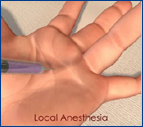
This surgery is usually performed in an operating room under local or regional anesthesia on
an outpatient basis as day surgery. Your surgeon makes a small incision to the affected palm area.
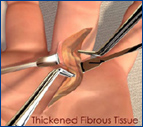
The surgeon then removes the thickened fibrous tissue causing the contracture.
The incision is then closed with sutures and covered with a sterile dressing.
Complications can be medical (general) or specific to hand surgery. Medical complications include those of the anesthetic and your general well being. Some of the complications associated with the surgery include:
- Infection
- Nerve damage causing weakness, paralysis, or loss of feeling in the hand area
- Injury to the arteries of the fingers/hand
- Recurrence
- Allergic reactions to medications
- Blood loss requiring blood transfusions
- Heart conditions
- Serious medical problems can lead to ongoing health concerns, prolonged hospitalization, or rarely death
Carpal tunnel syndrome and surgical release
Carpal Tunnel Syndrome is a common, painful, progressive condition that is caused by compression of the median nerve at the wrist area. Common symptoms of carpal tunnel syndrome include numbness and tingling sensation in all the fingers except little finger; pain and burning sensation in hand and wrist that may radiate up the arm and elbow; and weakness in hand with diminished grip strength Exact causes of the condition are not known. However certain factors increase the risk of developing carpal tunnel syndrome and they include congenital abnormalities, repetitive motion of hand and wrists, fractures and sprains, hormonal imbalance, and other medical conditions such as hypothyroidism, rheumatoid arthritis, diabetes, obesity, gout, overactive pituitary gland, or the presence of a cyst or tumor in the canal.
Carpal tunnel syndrome may be treated using conservative approaches or surgery. The conservative treatments include:
- Treating underlying medical conditions
- Immobilization of the hand and wrist with a splint or wrist brace for 4-6 weeks
- Rest the hand for 2 weeks or more
- Ice packs to avoid swelling
- Avoid activities that tend to worsen the symptoms
- Medications such as nonsteroidal anti-inflammatory drugs, diuretics, and steroid injections
- Strengthening and stretching exercises once symptoms diminish
If conservative treatment options fail to resolve the condition your surgeon may recommend surgical procedure.
Carpal Tunnel Release Surgery
Carpal tunnel syndrome can be treated with carpal tunnel release Surgery Traditional surgery involves up to a 2- inch incision in the palm and wrist area, whereas endoscopic surgery involves one or two half-an-inch incisions and the use of an endoscope. During the surgery, the transverse carpal ligament will be dissected to release the pressure on the median nerve and enlarge the carpal tunnel. Your surgeon will decide which options are best for you based on your general and medical conditions.
Your surgeon may suggest you to practice certain post-operative procedures for better recovery and to avoid further complications.
- Elevate the hand above heart level to reduce swelling
- A splint may be worn
- Ice packs to the surgical area to reduce swelling
- Keep the surgical incision clean and dry. Cover the area with plastic wrap when bathing or showering
- Physical therapy may be ordered to restore wrist strength
- Eating a healthy diet and not smoking will promote healing
The majority of patients suffer no complications following carpal tunnel release surgery. However some patients may suffer from pain, infections, scarring, and nerve damage causing weakness, paralysis, or loss of sensation and stiffness in the hand and wrist area. |


 Read more